
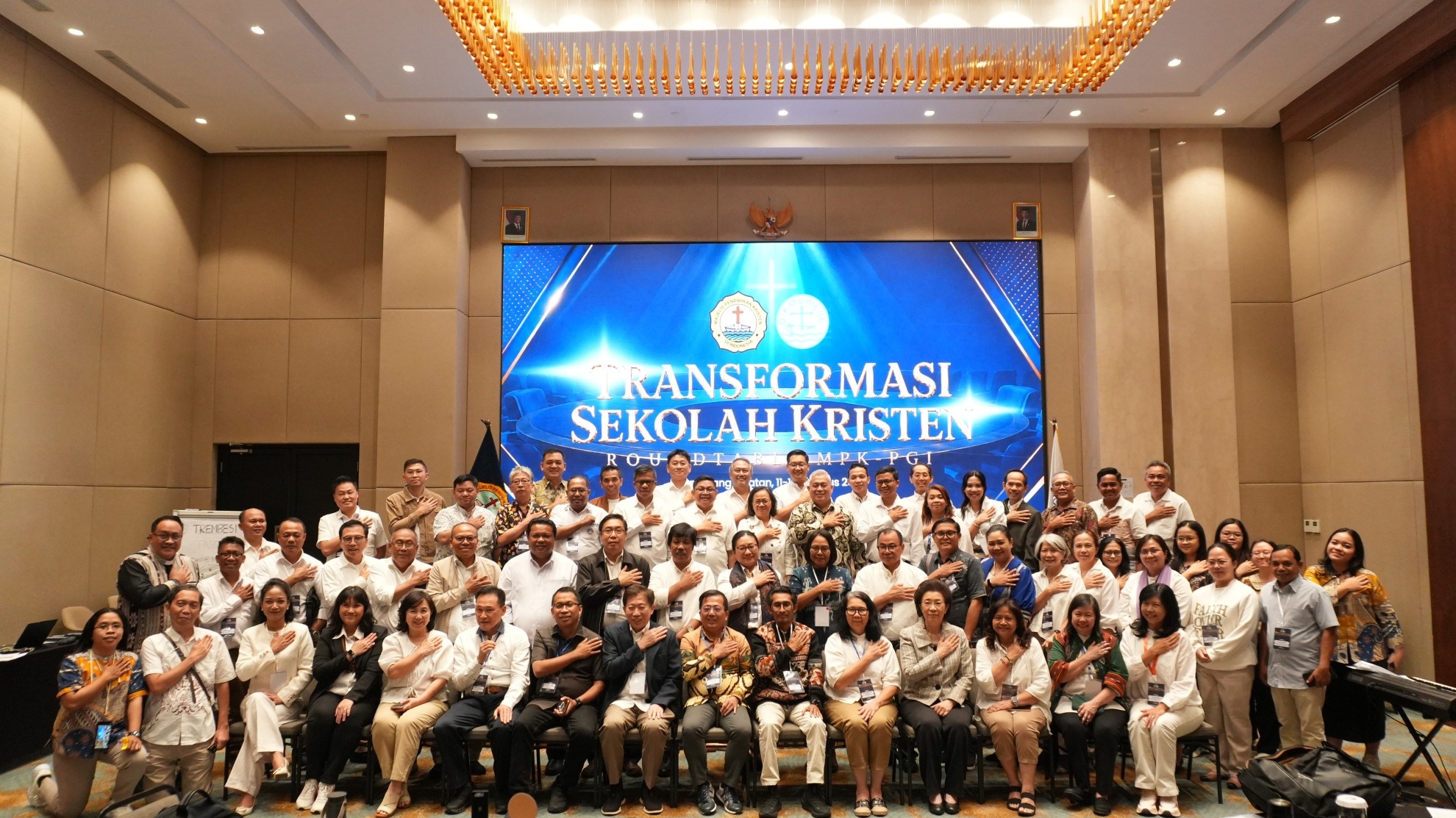
On 11–12 August 2026, Christian Education Council in Indonesia (MPK) together with PGI brought together leaders of synods, churches, foundations, and Christian education providers in the Roundtable MPK–PGI 2026: Christian School Transformation.
This meeting arose from both a concern and a hope: amidst the various challenges faced by Christian education, churches and schools cannot operate in isolation. Transformation requires a collective movement.
FROM CRISIS TO COMMITMENT
The entire Roundtable journey was structured with a clear flow:
CRISIS → AWARENESS → VISION → TRANSFORMATION → COLLABORATION → COMMITMENT → ACTION
Participants were invited to honestly examine the realities and challenges of Christian education, to revisit the true essence of Christian schools, and then to learn how transformation can be achieved through good practices, collaboration, mentoring, and the involvement of the entire education ecosystem.
The transformation of Christian education cannot be undertaken by schools alone. It requires the involvement of Churches, Synods, Foundations, Schools, Christian Education Council in Indonesia (MPK), PGI, the Government, the business sector, alumni, and all stakeholders.
The Roundtable was intentionally designed not as a one-way seminar. Participants discussed the main issues of Christian education, the strategic role of the church, the forms of collaboration needed, and concrete recommendations for Christian Education Council in Indonesia (MPK) and PGI.
The process moved from:
Group Discussion → Summary → Synod Presentation → Joint Commitment.
Each synod was then encouraged to formulate concrete steps according to their respective conditions and capacities.
This is where the Roundtable began to transform from a meeting into a movement.
23 SYNODS DECLARE JOINT COMMITMENT
The culmination of the Roundtable was when 23 Synods signed a joint commitment to drive the transformation of Christian education.
The commitment included the spirit to:
- Make Christian education a priority in church and synod ministry.
- Encourage Christian schools to become increasingly high-quality, relevant, and impactful.
- Strengthen school leadership, teachers, governance, and resources.
- Support the school transformation process sustainably.
- Build a culture of sharing good practices, mentoring, guidance, and learning.
- Strengthen networks and cross-synod collaboration.
- Mutually support and share resources for the advancement of Christian schools.
COMMITMENT BEGINS TO BECOME ACTION
Encouragingly, this commitment immediately began to yield concrete steps.
A number of synods expressed readiness to include their schools in the School Transformation Program (ST).
GMIT NTT, Gereja Toraja, GKE, Methodist Wilayah 2, HKBP, GPM, and GKP are among those who have stated their initial commitment, while GMIBM requested a special session to learn more about the program.
Several schools also began to express interest in becoming Model Schools and sending principals or teachers to attend training.
PAUD 1000 — BUILDING FROM THE FOUNDATION
This movement also looks far ahead through PAUD 1000.
A total of 11 Synods expressed initial interest in this program.
The next step is the recruitment of prospective Schools and prospective Mentors, in preparation for the 2027/2028 Academic Year.
This is not just about establishing or improving schools.
“We are talking about building the foundation for generations from an early age and leaving a legacy of faith for the next generation of Indonesia.”
A NEW AWARENESS IS GROWING
The Roundtable MPK–PGI 2026 demonstrated one important thing: that the transformation of Christian schools is not the responsibility of one school, one foundation, one synod, or even one organization. This is a collective calling.
Foundations need to strengthen governance and leadership.
Principals need to lead change.
Teachers need to continue growing and be role models.
Schools need to learn from each other.
Synods need to open networks and resources.
Christian Education Council in Indonesia (MPK) and PGI need to continue building an ecosystem of collaboration.
Because ultimately, what we are fighting for is not merely the sustainability of Christian schools, but the emergence of Christian schools that are relevant, resilient, high-quality, impactful, and hopeful for the Indonesian generation.
FROM ROUNDTABLE TO COLLECTIVE MOVEMENT
The Roundtable has concluded. However, the journey of transformation has just begun.
Dozens of schools are beginning to open themselves to the transformation process.
11 Synods are beginning to see opportunities through PAUD 1000.
The seeds have been planted. Now, faithfulness is needed to water, nurture, collaborate, and walk together.
We believe a transformation of this magnitude cannot rely solely on human strength.
May God Himself lead this movement, bring together the right people, open paths and provide resources, and use Churches, Synods, Foundations, Principals, Teachers, Christian Education Council in Indonesia (MPK), PGI, and all partners to bring about the renewal of Christian education in Indonesia.