
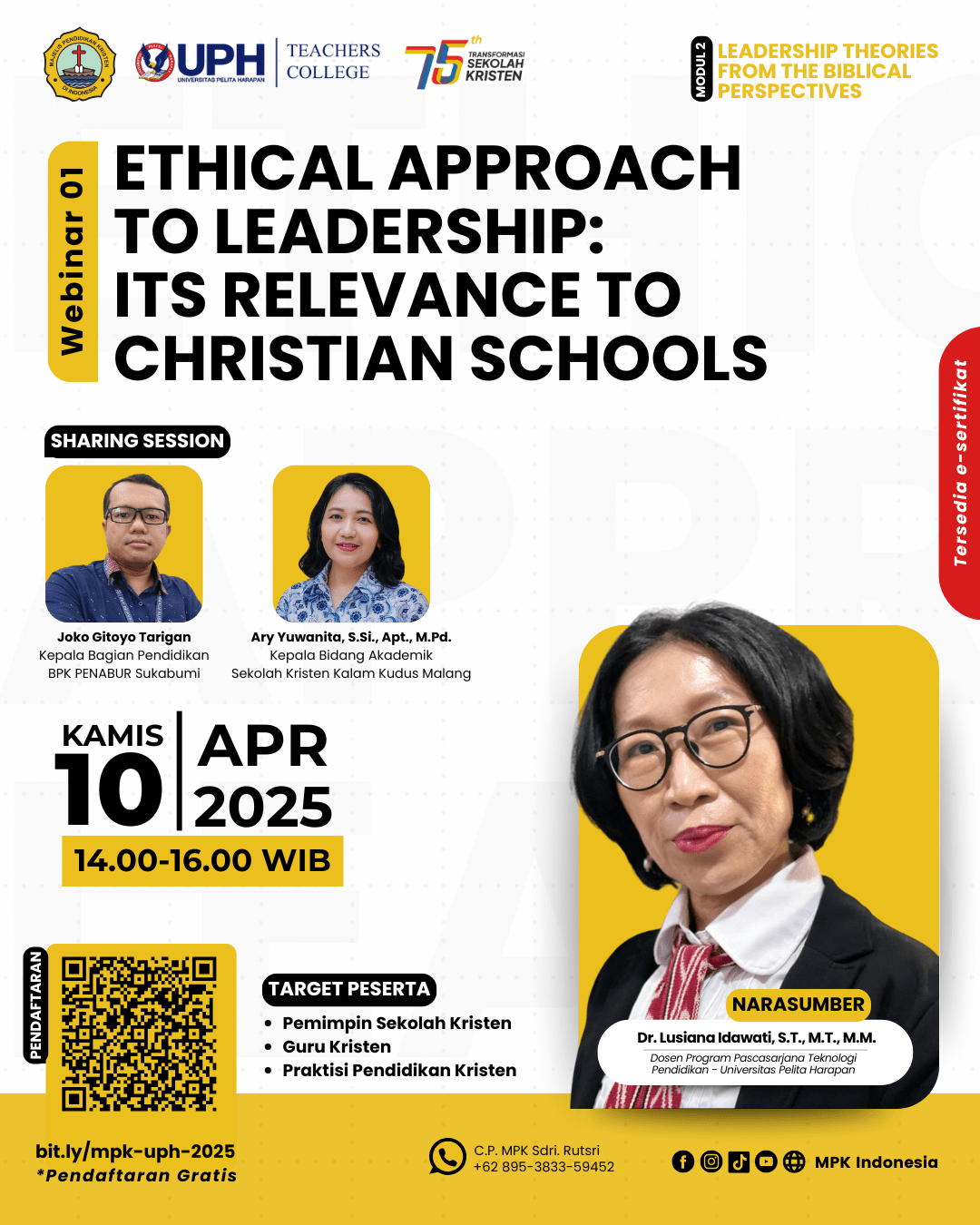
Thursday, April 10, 2025, the Christian Education Council in Indonesia (MPK), in collaboration with the Teachers College of Universitas Pelita Harapan, held Webinar Module 2: Leadership Theories from the Biblical Perspectives with the topic “Ethical Approach to Leadership: Its Relevance to Christian Schools.” This webinar is part of the "Bahas Bersama Manajemen Sekolah" (BBM – Discussing School Management Together) program and was attended by 435 participants via Zoom, consisting of school leaders, Christian teachers, and education practitioners from various regions.
Speakers and Inspirational Sessions
The webinar featured the following keynote speaker:
- Dr. Lusiana Idawati, S.T., M.T., M.M. – Lecturer at the Graduate School of Educational Technology, UPH
As well as sharing sessions from:
- Joko Gitoyo Tarigan – Head of the Education Division at BPK PENABUR Sukabumi
- Ary Yuwanita, S.Si., Apt., M.Pd. – Head of Academic Affairs at Kalam Kudus Christian School Malang
Summary of Material
The material presented emphasized the importance of an ethical approach to leadership, particularly within the context of Christian schools. Several key points discussed included:
- Ethical Leadership is built upon three foundations: right motive, effective action, and the leader's moral obligation.
- Three main ethical theories relevant to Christian leadership:
- Virtue Ethics (based on character and intent),
- Deontology (oriented toward duty and norms),
- Teleology (oriented toward results and impact).
- Virtue Ethics (based on character and intent),
- Christian Ethics views leadership as a reflection of being created in the image of God (Imago Dei), which serves as the foundation for the concepts of kingly, priestly, and prophetic leadership.
- Christian leaders are called to lead in faith, hope, and love, oriented toward justice, social responsibility, and humanizing relationships.
The material also highlighted core values in ethical leadership: integrity, justice, humility, empathy, and empowerment. Christian leaders are not only required to “do the right thing,” but also to “do it in the right way and for the right reason.”
Objectives and Expectations
Through this webinar, participants were invited to reflect on the theological and ethical foundations of leadership, as well as how to implement them practically in their respective schools. It is hoped that Christian leaders and teachers can become role models in building educational communities that reflect the love of Christ and the justice of God.
This webinar serves as a powerful opening for the next leadership module, which will be held on May 8, 2025, with the theme “A Biblical Perspective on Servant Leadership.”